Film Photography News — December 2025 Recap
Kodak A1 1st Impressions, 2026 Giveaways, & the Science of Impactful Images
8 min read by Dmitri, with image(s) by Daren.Published on .
☞ This is the 81st monthly Analog.Cafe Newsletter with the latest film photography lore. Sign up to get it via email on the last Tuesday of every month (it’s free).

In this year’s closing newsletter, I’ll share my first impressions with the Kodak Snapic A1, why I like this camera, and why it makes so much sense in 2026. I’ll also briefly cover the discontinuation of the Lomo MC-A, the new source of Kodak Aerocolor IV (SantaColor 100) — and why this film even exists, Spot One — a compact 1° light meter, and several new website perks.
🎁 Try GOLD free for 14 days — You may even win a free lifetime pass just by signing up! Members can download full PDFs, invert film scans with film Q, and access premium guides, apps, and newsletters.
In this newsletter: Lifetime GOLD membership giveaway! Kodak Snapic A1 first impressions. Free film. Spot One, a compact 1° light meter. Lomography discontinues the Lomo LC-A. New source of Kodak Aerocolor IV colour-negative film. Is film still used for aerial photography in 2026? How to Make Better Photos According to Science. Download and print all of Analog.Cafe! Latest on Analog.Cafe. Support this blog & get premium features with GOLD memberships!
Lifetime GOLD membership giveaway!
I’ve gotten into the habit of sweetening the deal for GOLD memberships. This year, I’ve been sending free film to randomly selected subscribers monthly. In 2026, I’ll be sending forever-free lifetime membership passes!
If you value the web apps, the guides, the experiments, the photo essays, and the 100% ad-free experience on this blog, a forever-free membership can be a handy thing:
With it, you can invert film negatives without altering the colours or crushing shadows/highlights with film Q. Track your film and chemicals with the least effort and avoid disasters with Film Log & Chem Log. Download and keep any article as a printer-friendly PDF document — especially handy with book-length ones, like “A Beginner’s Guide to Film Photography.” Learn how I pushed HP5+ to ISO 100,000. Access all 700+ articles on photography. Etc., etc.
To enter, you just need to be an existing member or sign up.
I will announce a random winner on the last Tuesday of every month in 2026. If it’s you, I’ll apply a perpetual 100% discount to your account!

Kodak Snapic A1 first impressions.
Kodak Snapic A1 is an easy camera to dismiss based on its specs alone. But ergonomics, feel-in-hand, design, control, layout, sound, viewfinder, reliability, and price are often more important determining factors of a “good” camera.
➜ Listen to the Analog.Cafe Podcast where Daren and I discuss this camera as we test it, develop, scan, and review the results on the same night: Spotify| Apple Podcasts | iHeartRadio | Overcast.

Eight+ years of reviewing film cameras has taught me that specs can be less important than a good understanding of user needs, thoughtful planning, and quality workmanship. Having played with the Snapic A1 for a few days, I’m convinced it’s the best new pocketable film camera of 2025 despite its small, fixed-aperture lens, fixed 1/100s shutter, and no autofocus.
It’s cheaper than all new point-and-shoot options, it’s smaller than all of them, with the exception of Rollei 35AF (even then, the A1 will fit better in your pocket since it’s slimmer — and it comes with a motorized film transport, whereas the 35AF’s film advance is one of its weak points).
This camera also appears to be well-made. Yes, it’s plastic, and yet it mimics the highly-regarded Ricogh GR1/R1 ergonomics, and the body construction feels as good as or better than on the Olympus XA and Voigtländer Vito C.
I like the backlit LCD and the comfortable viewfinder with parallax marks. The camera is quiet, lightweight, and very easy to hold. I’ve even been surprised by a hidden autoexposure feature — auto flash, which turns on automatically for scenes lit under 2000 lux or ~EV 10.
I spoke to Daren on the Analog.Cafe Podcast about the A1 to get his opinions and, perhaps, dispel some of my biases. But as you’ll glean from our conversation, there aren’t many things not to like about this camera.
Still, these were our first impressions — full review, with many more samples, coming next year (very soon)!

Free film.
I’ve been giving away film to GOLD members at the end of each month all summer and fall. This is the last one!
The winner is:
🎈Andrei, 🎈
Congratulations! I’ve sent you an email with the next steps.
Spot One, a compact 1° light meter.
Though I generally opt for the Sunny 16 rule, built-in meters, and an iPhone app, there are plenty of reasons to use a dedicated spot meter for your photos.
What I like about this product is the designer’s focus on optical and internal component quality, but in smaller batch runs, thanks to the 3D-printed shell.
Spot One is currently priced at €222 (early bird) on Kickstarter, with an estimated delivery around May 2026.
Lomography discontinues the Lomo LC-A.
Lomo LC-A was the original Soviet camera design that Lomography has used for decades to sell its highly regarded cameras. This camera’s chassis is at the core of the new Lomo MC-A point-and-shoot, but unfortunately, it has been discontinued.
More details in this post and Kosmo Foto’s original reporting here.
New source of Kodak Aerocolor IV colour-negative film.
Kodak Aerocolor IV is sold under several names, including SantaColor 100, Luminar 100, Film Electra 100, Film Washi X, and others.
It’s a colour-negative aerial surveillance film that’s still being made and sold for professional applications. It’s not infrared-sensitive (like Aerochrome), although it has a clear film base that sets it apart from other colour films and makes easier to invert.
Camera Rescue discovered this film several years ago and raised enough funds to buy it in bulk. Other brands followed, which, commulatively, gave us a “new” ISO 100 colour-negative film.
But in 2026, Camera Rescue will hand off spooling and cutting production to the Optik Oldschool — a business by a Düsseldorf film lab that’s also brought us the new OptiColour 200 film.
Hopefully, this means DX codes and improved distribution (so that more of us can shoot this film!).
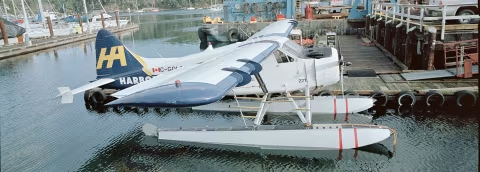
Is film still used for aerial photography in 2026?
SantaColor was announced in June 2022 as a new source of fresh Kodak film. The project began as an IndieGoGo campaign to raise funds for a €125,000 minimum order. Which begs the question:
Who uses such high quantities of film for scientific purposes in 2026?
It appears that many government and private contractors do. GPSi, a US-based aerial survey and mapping service, offers aerial photography on film. Canadian Challenger Geomatics also has film as an option for its photogrammetry. British Antarctic Survey hosts a page about specialist film cameras. Plus many more.
The planes that carry aerial photographic cameras like the Leica RC30 carry large magazines with 240mm-wide, 150m-long rolls of film (9½” × 492’) to capture ultra-high resolution images in succession.
That’s a lot of film!

How to Make Better Photos According to Science.
Despite billions of new images shared and published every year, only a few will remain memorable for the people they were meant to affect.
Most of us hope to make photos that look good in one way or another, perhaps something that makes a lasting impact. But given the infinite visual possibilities, it can be hard to know what would work best, especially on a medium like film, which can’t be previewed.
Unfortunately, online tutorials, books, and even university-level courses will often offer little guidance beyond authoritative opinions rooted in tradition. Some of these opinions have been shown to be ineffective (like the rule of thirds), and others may be useful only by chance.
This month’s new guide, “How to Make Better Photos According to Science,” fills that gap with a world of knowledge typically excluded from our hobby/profession.
In it, I review recent and historical studies that explain what compels our minds to prefer certain types of images and apply those insights to the art of photography.
The article goes beyond composition, colour, and first impressions, diving deep into cultural and other paradigms. It’s based on a lot of jargon-filled reading, which I adapted to be just as easy to understand as the rest of the content on the blog.
This is your chance to deepen your understanding of art and photography through scientific knowledge in the new year! 🥳
Download and print all of Analog.Cafe!
It’s the holidays. Perhaps it’s best to turn off the laptop and put away the phone. But that doesn’t mean you can’t learn from or browse the pages of this blog!
GOLD members can download, keep, and print virtually any article. This is not just a facsimile for a “print” button — it’s a complete redesign of all the content to fit perfectly on standard printer sheets, easy to read, and a pleasure to look at on the glorious tactile sheets of paper.
Simply go to an article that you like and click the “Download PDF” button at the top. Details.
Hope you found this email a helpful and fun read. Feel free to add a comment or reach out anytime. 👋