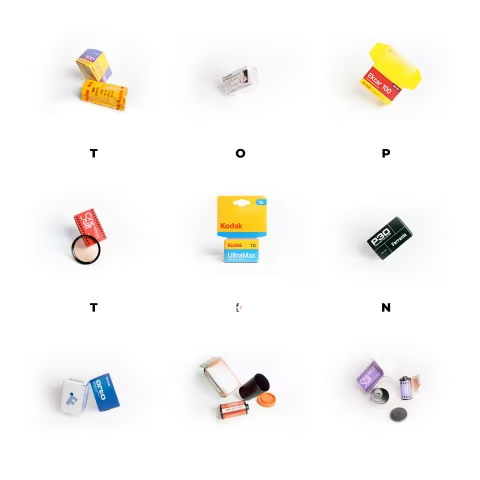
Top 10 Films & the Aesthetic Science of Photography
A Monthly Newsletter for GOLD Members
5 min read by Dmitri.Published on .

These last few days of 2025, I ran through the Analog.Cafe data to surface the top 10 most-used films, added an early warning system to Chem Log, and published an article with the latest research in aesthetic science, which explains what makes our photos good.
This is also the last month I’m giving away free film! In this newsletter: Free film & Black Friday deals. Early chemical expiration warnings. Top 10 film stocks, according to 293 photographers. What makes photos better? (according to science). Support this blog & get premium features with GOLD memberships!
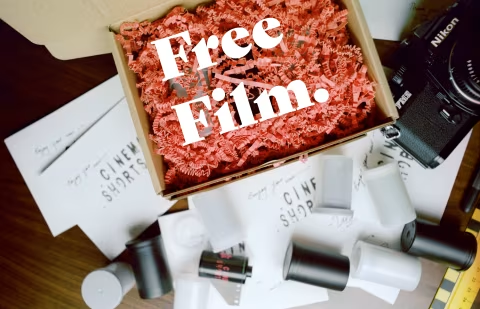
Free film & Black Friday deals.
If you aren’t yet a GOLD subscriber, here’s a little incentive for you: I’ve been giving away 3-packs to random people once a month since summer — and you can be the final winner of 2025!
All you need to do is subscribe and wait for an announcement in the next newsletter on December 30th, when the last draw for the current batch of hand-rolled films will take place!
Early chemical expiration warnings.
Don’t you hate it when you develop your film in expired or exhausted chemicals and it comes out with botched colours, contrast, or blank?
Even if you test your chemicals, it can still be frustrating to discover that the fixer, bleach, or developer isn’t good and you need to get a new one. Usually, this happens after the film is already in a Paterson tank, and all the tools are neatly laid out.
I built Chem Log for tracking mix dates and the total number of processed rolls for each chemical. The web app integrates with Film Log, so all you need to do to keep these records is select the chemicals you’re about to use once you advance your film from “Done” to “In Development.”

The apps are designed to be out of the photographer’s way, requiring only a film and a camera name (with optional free-form notes). However, the other day I discovered that they were somewhat too passive: my fixer was nearing expiry, but there was no warning. While Chem Log had that information (that’s how I knew that my fixer is a year old), it wasn’t obvious enough for me to notice.
So I spent a weekend developing an early-warning system. Visually, it’s not very complex: chemicals that need attention are simply automatically highlighted in red or yellow (and you’ll see that in both of the apps). However, the rules for these highlights took some figuring out — you can learn how they work in last week’s Chem Log announcement.
Top 10 film stocks, according to 293 photographers.
I came across two distinct scam links and zero useful information while researching the list of the top-most popular film stocks.
It turns out this type of information is hard to come by, as no one source can have a complete picture. Film shops can only account for the films they have in stock, which is never the entire universe of photography; distributors are only concerned with their service areas; and film manufacturers only know how many rolls they made (but not how much was used, or how much was made by the competition).
This leaves Analog.Cafe readers as the best source for this answer. In particular, the several hundred of you who use the Film Log app to track thousands of individual rolls.
To learn how I processed the anonymized data (it wasn’t easy!) and which stocks made the list, check out this article.