A Film Photographer’s Note-Taking App
*Film Log* Is a Digital Memo “Holder” for All Your Film Cameras
5 min read by Dmitri.Published on .
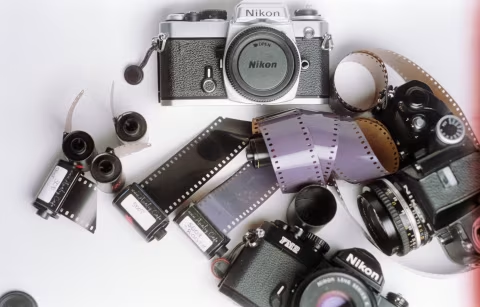
Film cameras advanced photography from nil to near-perfection in the past 200 years. Still, they could never fully fix the metadata issue — only digital cameras can record date, location, filter, camera, and exposure settings seamlessly.
While it may not be necessary to record anything to take good film photos, you still need to know your film’s ISO, type, and any push/pull plans to get the exposures right. Failing that could ruin the images.
Point-and-shoot cameras that read DX codes may work just fine without any notes — unless you’re shooting unusual film or plan to expose your film in a specific way (push, pull, overexpose, set a custom ISO, etc.).
If you happen to leave your camera on a shelf for a while or if, like me, you have several cameras, you may even forget whether there’s anything inside. That’s another path to disaster, as opening the camera back while exposed film is inside is a very common occurrence.
Flawed solutions.
Film photo record taking has been a chore with no easy solution since the dawn of photography.
Some older cameras used a built-in memo dial — a physical knob with several film brands and exposure conditions (daylight, shade, flash). Those film brands, mostly extinct, weren’t representative of the market even at the time of manufacture; they were usually associated companies that paid to appear there.

These memo dials are as beautiful as they are useless today.
Later, camera manufacturers built frames on the back of the camera where you could mount a piece of cardboard, a “tab,” from the film inside. But of course, not all the cameras used this and not all films come in neat cardboard boxes; this solution only works for some films on some 35mm cameras. All other film formats are excluded.
Modern solutions are apps, sometimes filled with ads and at other times with many convoluted steps that require you to enter a lot of info after each photo. These apps parody paper booklets where diligent photographers could write notes about each shot taken to (maybe) use that information down the line. Though helpful at times, this is a lot of work, likely to create a lot of mess and make photo shoots center on note-taking rather than picture-taking. No matter the automation features (like the mostly unnecessary, somewhat invasive location-tracking data) and the gimmicky gadgets that simulate paper tabs with mini displays, these tools require a serious time investment on your part.
And what happens when those apps inevitably break down or go out of service?

Film Log — the easiest way to take film & camera notes.
I built Film Log specifically to address those problems.
Film Log merges the simplicity of a memo holder with a modern interface and data transfer design. It’s a web app that works on any device — and it lets you download everything into a readable spreadsheet format, should you like to back up your film story.
All you have to do to use it is to jot down your film and camera name. Once you’re done shooting, simply advance your roll to the next step. There are four steps in total: Film in Camera to Done Shooting, Film in Development, or Scanned/Archived.
There’s absolutely nothing else that you need to do to keep a good, well-organized record of all your films indefinitely.

Of course, if you want to, you can add detailed notes about your film exposures, or anything you wish in the freeform “Notes” section of the app. Just hit the “...” button to get going.
You can undo your last step and move your records between steps easily. And as you do that, the info is saved securely onto Analog.Cafe servers.

Film Log will also show a neat graph of your film usage throughout the years and offer shortcuts for film development tools like a dilution calculator (for home black-and-white film development).
Film Log also seamlessly integrates with Chem Log — a tool for managing your film chemistry (very helpful to track expiration and exhaustion).
Please note that Chem Log and the option to download records requires a GOLD account, which comes with a slew of features for a small monthly fee.
Otherwise, Film Log is completely free and you can even try it anonymously (it will store the data in your browser only). There’s nothing to download — it works like a regular web page.
Film Log has been online since May 2022, yet it has no equals in simplicity, flexibility, and accessibility.
I hope you enjoy this app — and if you have any issues, please reach out. I’m happy to fix them for you and answer your questions directly.