SMC Pentax-M 1:2.8 40mm Pancake Lens Review
Super-Slim, Affordable, Full Manual Control, and Solid Chassis — What’s Not to Love?
9 min read by Dmitri.Published on .
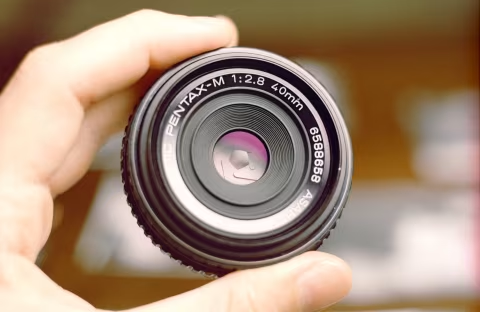
SMC Asahi Pentax-M 1:2.8 40mm pancake is the slimmest manual lens for this mount. Introduced in 1976, it offers complete focus and aperture control while protruding just 18mm/.7”.
With this lens, my Asahi Pentax MX becomes a pocketable full-frame SLR, a quality I missed after selling my insanely slim Olympus PEN FV + 1:2.8 E.Zuiko Auto-S combo.
In preparation for this review, I’ve noticed that public opinion on whether this lens is sharp or not is split. TL;DR: This lens is sharp. This review includes 6MP+ 4K scans without any sharpening — use those to guide your opinion.
I explain the nuances of this ultra-slim vintage lens’ optical qualities and my experience shooting with it on a native mount (plus some thoughts about adapting to digital cameras) below.
In this review: Ergonomics & build quality. Image quality. Adapting to digital and other mounts. Where to buy. Support this blog & get premium features with GOLD memberships!

Produced from 1976 to 1984, the SMC Asahi Pentax-M 𝒇2.8 40mm is an ultra-compact, relatively affordable vintage full-frame SLR lens that sold for an average of $150-$200 on eBay in Q4 2026. It’s fairly easy to find; there were 12 results available on the US site at the time of writing.
Focal length: 40mm.
Closest focus distance: 60cm/1.97’.
Aperture size: 𝒇2.8-𝒇22 with half-stop clicks, 6 blades.
Angle of view: 57° diagonal on a full-frame/35mm film (39° on APS-C).
Filter thread: 49mm (a very common size).
Formula: 5 elements, 4 groups.
Weight: 110g/3⅘oz.
Dimensions: 63mm (2½”) diameter, 18mm (0.71”) length from the mount, when set to infinity.

Ergonomics & build quality.
If you like manual SLR lenses and need a pancake, the 40mm Pentax-M may be your best option. It’s probably the slimmest SLR optic in this category: fitting controls in such a crammed space may not even be practical if it shrank any further.
The focus and aperture rings are so slim that they’re hard to grasp unless the lens is mounted on the camera — its entire outer surface is the grip.

Once mounted, I found no issues grasping the rings with my average-sized (man) hands.
If you’re using your lens with a Pentax camera that has a small window in the pentaprism, it’ll read the aperture numbers into the viewfinder — this still works with this lens. If you’re looking for the signature white plastic bump, it won’t be there; I didn’t find any other missing features compared to a “normal”-sized lens, like the kit 50mm SMC Pentax-M.
Aside from the focus ring’s grip surface, the entire lens surface is either glass or metal. Given its age and origin, I’d expect either all or the vast majority of internal components to be metal as well. This is not a knock on plastic components, as they could still be made reliable and light, but at 110g (3.88oz), this 40mm Pentax-M is both featherweight and delightfully solid.
On my copy, the focus ring rotates freely with minimal dampening; the aperture ring is a little sticky, though I don’t expect this lens to be particularly difficult to clean and lubricate at home. I’m just lazy.

Image quality.
The most common complaint about this lens that came up during my research for this article is softness when shooting wide-open (i.e., with the aperture set to its widest, 𝒇2.8). I’m not convinced it’s fair.
While some lenses can perform exceptionally well at their maximum aperture, it’s not the sharpest setting. This fifty-year-old lens may not be as sharp as some modern counterparts, but I don’t think it’s underperforming. It’s exactly as sharp as I expect it to be, rendering images about as well as its full-sized counterpart, the SMC Pentax-M 𝒇1.7.
A good lens is just a part of the ensemble when it comes to making sharp photos. This guide shares 23 techniques for making sharper photos on film.

Being a full-frame lens with a close focus distance of less than a metre, the 40mm Pentax-M will render noticeable bokeh even at 𝒇5.6. I found it smooth, with a slight swirl and overcorrection.
As with any other lens, you can turn the 40mm Pentax-M into a macro lens and push bokeh to the next level with extension rings. Here’s what that looked like:

Flaring. I’ve been testing this lens for just over a year, and I’m yet to find any results with prominent flares. The best example may be the sunset over the mountain range (below) where the camera points directly at the sun. That may not be the best way to render flares (typically, the bright object should be to the side), but the complete lack of flare-like issues in that image is notable — not all lenses of that age perform this well. To be sure, I’ve shone a flashlight directly at the lens — it does flare, yet the effect is fairly subdued, less so than on a larger, highly regarded SMC Pentax-M 𝒇1.7. If I ever get this lens flare meaningfully, I’ll update this post.
While it appears to be flare-resistant, which may be a side-effect of its small size, the 40mm Pentax-M is still a medium-contrast lens.
I like the images I get from this lens. They’re detailed and pleasing to the eye; there are more of them because I can keep a small camera on me most of the time. The only time I replace my 40mm Pentax-M with a faster 50mm is when I shoot product photos. Close-ups under subdued light may not be its strong suit.


I like this lens a lot, but like all products, it has some drawbacks. In the case of the 40mm Pentax-M, it’s the chromatic aberration. Typically considered less of a problem on film, it’s worth knowing about, as some images with backlit elements can show blue and purple fringes (see the leaves against the sky in the top-left corner — you’ll need to zoom in):

Still, in most cases, the chromatic aberration isn’t noticeable. A few more samples:


I’ve checked my library for examples of coma, barrel, and other types of distortion and found none. This lens has very few downsides.
Adapting to digital and other mounts.
While many photographers appreciate this lens’ form factor on their digital SLRs and mirrorless cameras, I would still prefer mine on its native film mount. Chromatic aberration aside, I’ve come across complaints about vignetting — but the main issue is that it’s simply not as small as it could be with a compact film body like the Pentax MX. It’s also the wrong choice if you aren’t comfortable with setting your aperture manually; plus, a SMC Pentax-DA 40mm is much slimmer.
Where to buy.
This lens isn’t hard to find on major used gear marketplaces like eBay. When I did a quick search just before writing this, I found 12 results, priced $150-$200. This is considerably less than what I expected, but then again, the Pentax-M is known for its great value/price ratio.
❤ Please consider making your SMC Asahi Pentax-M 1:2.8 40mm pancake lens purchase using this link so that this website may get a small percentage of that sale — at no extra charge for you — thanks!