Ilford HP5+ Film Review
A True Standard of Quality and Versatility Since 1931
13 min read by Dmitri.Published on . Updated on .
Ilford HP5 Plus is one of the best-known and longest-living film products. The first HP (short for “Hypersensitive Panchromatic”) was introduced in 1931 for dry plate cameras. Today, it’s available in a large variety of roll and sheet sizes from 35mm to 20x24” as it remains one of the best-selling black-and-white films ever made.
Not only does this film boast impressive history and longevity, but it is also widely regarded for its ability to withstand harsh exposures and extreme processing needs (such as in my recent experiment, where I pushed HP5+ to ISO 100,000!).
I’ll share my tips and impressions after many years of using and abusing this film in this review. But first, let me introduce you to Ilford HP5+’s rich history and impressive specs.
In this review: A brief and very confusing history of the Ilford film brand. Hypersensitive Panchromatic 1, 2, 3, 4, 5, and 5 Plus. Grain structure, resolution, and sharpness. Dynamic range and contrast. Ilford HP5+ exposure guide. Developing Ilford HP5+. Developing Ilford HP5+ cannabis, coffee, moss, fir, cedar, blood, pond water, EpiPen, and pee. Pushing and pulling Ilford HP5+. Scanning and post-processing. How much does Ilford HP5+ cost, and where to buy it. Support this blog & get premium features with GOLD memberships!
A brief and very confusing history of the Ilford film brand.
The Ilford brand, recognized on black-and-white film packaging, is currently operated under a license by Harman Technology. This confusing situation is the result of a 2004 bankruptcy that split the company into two, leaving the rights for the Ilford name to a Swiss chapter. But the Swiss don’t make any film; instead, Harman, located in the UK, operates the factory that makes the film and “rents” the Ilford brand to place on their black-and-white films.

If that’s not confusing enough, consider that Harman can not use the Ilford name on its new colour film, which is why it’s called Harman Phoenix. But Ilford Imaging Europe GmbH (the Swiss), as an owner of that name, uses it to rebrand ORWO Wolfen NC500 films as Ilfocolor 400. But that’s another story.
Harman is the company founder’s last name, Alfred Hugh Harman, who founded it in his basement in 1872, 52 years after the first photograph was made. But don’t worry, there are more names to learn: the company was called Britannia Works. Nope, Alfred lost that name in a lawsuit, so in 1886, the company was finally named Ilford, after the town it was located in. Except that it was selling the film under the Selo brand between the 1920s and 1940s, around the time the film I am reviewing here was introduced.
No more names, I promise.
✪ Note: I will be referring to the company as Ilford from hereon.
Hypersensitive Panchromatic 1, 2, 3, 4, 5, and 5 Plus.
The name HP5+ expands to Hypersensitive Panchromatic, version Five Plus — a designation the product got in 1989 — and it hasn’t changed since (or if it has, the changes weren’t significant enough to warrant a name change).
This film was first introduced as simply HP in 1931 for dry plates only and expanded to roll film production in 1935. Given that this predates Kodak Tri-X’s launch in 1940, Ilford HP5+ may be the oldest film formula that’s still in production.
The formula was updated in 1939 to HP2, then in 1941 to HP3; in 1965, it became HP4, and in 1976 it was HP5.
Not much is found online about these formula updates, yet the eventual launch of HP5+ was apparently a big deal:
1976. Ilford launch their new 400 ISO HP5 film at Photokina. Initially there was a world shortage of this admirable product. The first batches of HP5 were exclusively in the 35mm format and were only sold in Germany, a country selected because it was (at that time) the most profitable marketplace.
Curiously, many of the improvements HP5+ gained over its plus-less predecessor were apparently tailored for press photographers (Photo Pro issue 4, 1989). Pushability up to ISO 3200 was one of them. So was the slightly finer grain and more shadow detail than its fierce competitor for the press market, Kodak Tri-X.
As of this writing, 36 years have passed since the last formula update and 94 years since the introduction of the Hypersensitive Panchromatic to the market. Yet the film remains as one of the longest-living and best-selling photographic products ever created.
Ilford HP5 is our best selling black-and-white film, and probably one of the best selling black-and-white films in the world.

Grain structure, resolution, and sharpness.
Whereas Kodak has traditionally measured and published the grain properties of their film — in RMS and, later, in PGI — Ilford does not. Still, with enough enlargement, it’s easy to see that HP5+ is fairly grainy, even when shot at box speed. Based on looks alone, I’d guess it’s slightly grittier than Kodak Tri-X 400 (which has a granularity index of RMS 17 when developed in Kodak HC-110). That’s significantly grainier than, say, Fujifilm Neopan Acros, which has an RMS of 7; however, that film boasts the finest grain for ISO 100 films.
As with any film, the grain size will depend on exposure, development chemicals/methods, and even the way you scan it. Ilford recommends Ilfotec DD-X for finest grain and “best overall image quality.” I recommend a dedicated film scanner, such as the Nikon SUPER COOLSCAN 5000ED, and film Q for inverting the negatives without losing any shadow or highlight detail.

If you want finer-grain ISO 400 black-and-white film, however, consider Ilford Delta 400 or Kodak T-Max 400 — these films use technology that flattens the crystals to create more definition, though they won’t be as flexible or as forgiving as traditional grain films such as HP5+.
Dynamic range and contrast.
With the right filters, developers, and developing technique, you may be able to get even smoother grain than what I’ve got here (all samples are shot in 135 format). Yet, the biggest reason to shoot HP5+ and its main advantage is its dynamic range, which gives it unprecedented flexibility and the wonderful capacity for having bad exposures restored in post.
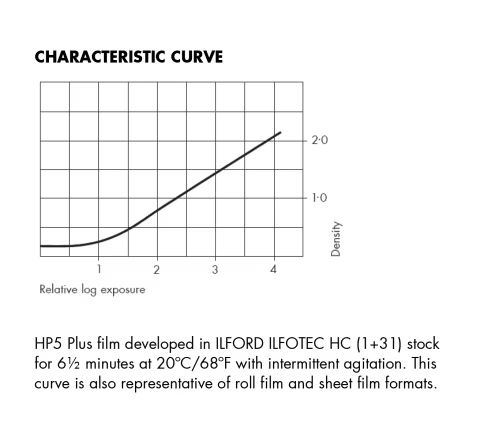
On paper, HP5+ shows 3.5 lux-seconds of useful exposure. This converts to about 12 stops of usable dynamic range.
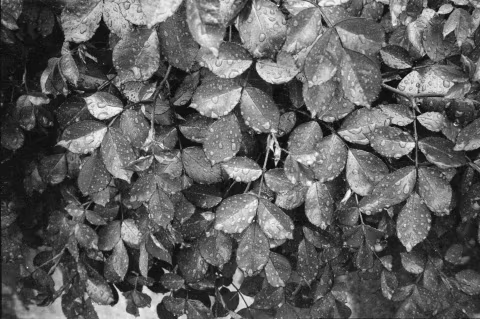
In practice, HP5+ can capture details from difficult lighting conditions better than most, if not all films. Thanks to its generous latitude, this emulsion handles harsh light better than some top-of-the-line digital sensors in 2022. Naturally, this makes HP5+ suitable for beginners and for metering light without a light meter and learning the Sunny 16 Rule.
HP5+ behaves as a medium contrast film when exposed perfectly. However, it’ll give you more contrast if you under-expose it and slightly less if you over-expose. All black-and-white negative film does this, though HP5+ does it better than most: its shadows retain more detail than many comparable films (including Tri-X), and its highlights are least likely to get washed out by over-exposure.
Just look how well it handles the extreme transition from a sunlit white-paint Vespa to deep shadows under a sprawling tree in this Hanoi scene from 2018:

This photo was taken before I learned to pay attention to exposures like I do today, developed in the simplest chemical mix possible, and scanned without any edits at all.
Ilford HP5+ exposure guide.
As an ISO 400 film, HP5+ will, of course, work as expected. In full sun, you should probably set your shutter to 1/500s and aperture to 𝒇16 to get a perfect exposure. You won’t be disappointed.
But there’s more.
Not all film cameras have shutters that can fire this fast, which isn’t really a problem with this film. You can rate HP5+ at EI 200 (that is, shoot as if it were ISO 200 film) and develop normally. Your highlight details will still be there, whereas your overall contrast will decrease slightly — something you can adjust after scanning or in the darkroom without much trouble. You may even have no issues shooting this film in toy cameras that have a fixed shutter speed of 1/100s, as long as you can get a good scan and make some adjustments afterwards.
Likewise, HP5+ rated at ISO 800 and developed normally, will still work fine. Expect more contrast and perfectly usable images.
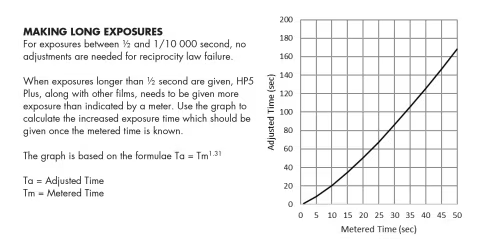
That said, if you’re planning to take long exposures (anything longer than ½ second) or the unlikely ultra-fast exposures (anything faster than 1/10,000 second), you’ll need to refer to the reciprocity failure chart above. For example, if you’re metering a 10-second exposure, you must double it to 20 seconds, as this film (same as most films) will lose sensitivity at such speeds. For values not shown in the chart, you can use a calculator to estimate exposures like this: 10s (metered) = 10^1.31 = 20.4s (actual).

Developing Ilford HP5+.
HP5+’s appeal extends to the development process. For starters, it’s “less sensitive to over processing,” writes Ilford, which makes them “ideal for people learning about film photography.”
Indeed, you’ll soon see that Ilford HP5+ is a film that’s ideal for a huge range of enthusiasts — from beginners to experimental and professional photographers.
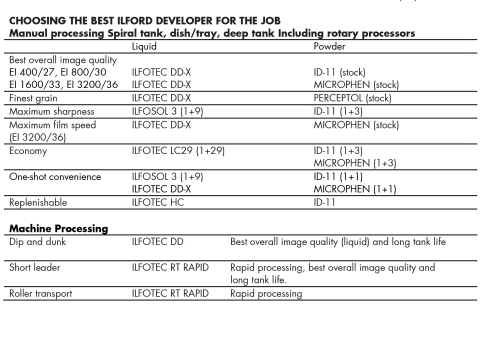
Ilford’s technical information sheet includes some guidance for the company’s own developer line. But if you want times/ratios for developers from other brands, Massive Dev Chart has an outstanding repository for this info.
A word of warning: Massive Dev Chart’s times are based on photographers’ estimates, often drawn from personal experience. For popular films like HP5+, you can generally consider them reliable, but these numbers may still be off for some newer films or developers/methods. Thankfully, this Ilford film is so resilient that such mistakes may not be significant enough to cause any noticeable issues.

Developing Ilford HP5+ cannabis, coffee, moss, fir, cedar, blood, pond water, EpiPen, and pee.
Traditional developers like Ilford DD-X or Rodinal aren’t the only chemicals that work with HP5+.
Last year, Daren, Yvonne, and I tested a slew of homemade potions, including cannabis (see photo above), pig’s blood, along with some more “traditional” homemade solutions, such as Caffenol.
For results, tested at several exposure levels and chemical concentrations, and precise formulas, including Sativa Cannanol 420, check out “Developing Film in Cannabis.”

Pushing and pulling Ilford HP5+.
Ilford HP5+ is loved for its versatility. It can be exposed at a wide range of speeds without significant loss of quality and developed in homemade solutions. Yet one of the most common non-standard uses of this film is push-processing.
If you have the capacity to develop your black-and-white film at home (or for a small fee at some labs), you can shoot HP5+ as if it’s an ISO 800, 1600, 3200, or faster film. While this is possible with most films, HP5+ is very good at retaining its characteristics when push-processed.
In fact, HP5+ is so good at holding up when pushed, I’ve shot and developed it at EI 100,000!
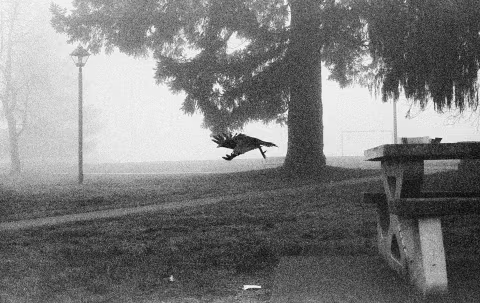
While not exactly practical due to the time it takes to develop this film to approximate an ISO 100,000 emulsion (and the shutter speed required to shoot in full sun), HP5+ can also be pulled to an equivalent of ISO 3.
Many would consider ISO 3 to be too slow, but in practice, this speed is perfectly usable in full sun with an 𝒇1.4 lens and a 1/500s shutter. The advantages are finer grain and much faster development times.
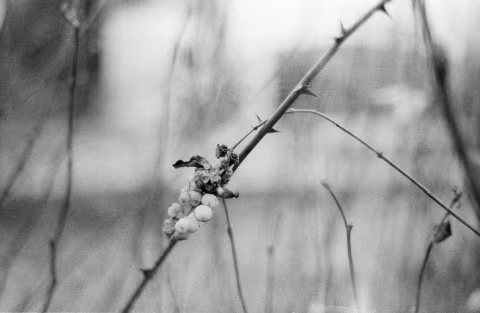
Of course, ISO 3 and 100,000 are the extremes of this film’s abilities. The examples shared on this blog are the only documented evidence of HP5+ pushed and pulled this far. Most applications don’t require going beyond -1 or +2 stops — and yet, it’s good to know that something like this is possible.
Scanning and post-processing.
Black-and-white film is typically easier to scan than colour negatives. HP5+ makes the task user-friendly by drying flat and retaining its maximum density (D-max) at 2, giving non-dedicated, lower-end film scanners a better chance of accessing highlight details.
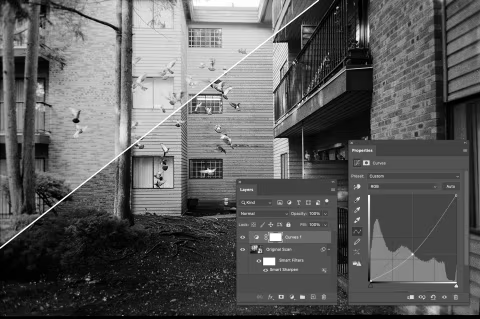
Better yet, a good scan of HP5+ will respond well to contrast curve adjustments, which isn’t a given for all black-and-white films. Both Tri-X and Acros, for example, show noticeable loss of detail and grain exaggeration with even slight contrast changes.
I think it’s worth noting that none of the contrast adjustments I’ve made to my scan required a 16-bit TIFF. While a high-quality scan is certainly an advantage, a 5MB JPEG file is perfectly capable of retaining all the information needed to make HP5+ look good, with or without edits — even in print.
How much does Ilford HP5+ cost, and where to buy it.
HP5+ is available in more formats than most other films. Though I haven’t seen it for sale in 110, 120 rolls and large format sheets are sold at most stores that specialize in analogue photo gear. You can even order ultra-large format sizes during Ilford’s annual ULF sheet film ordering window.
As of November 2025, a single roll of 35mm/36exp. Ilford HP5+ costs an average of just over $11.60. Its price has been increasing along with general inflation; still, it remains one of the cheapest and most reliable films you can buy today.
If you like this film, you can save by buying it in bulk. Here’s how.
❤ By the way: Please consider making your Ilford HP5+ film purchase using this link so that this website may get a small percentage of that sale — at no extra charge for you — thanks!