Kodak Charmera (Y2K) Review
A Keychain Toy Camera That’s Fun in a Simple, Wholesome Way
16 min read by Dmitri.Published on .

Kodak Charmera is a tiny camera — barely enough to hold in hand — made to live on a keychain. It’s lo-fi and completely disconnected (aside from a MicroSD card slot and a USB-C port for charging and downloading images).
In this review, I will explain why this camera is so appealing today, share plenty of samples and facts, and offer tips for making better photos with Kodak Charmera.
In this review: What is Kodak Charmera? Kodak Charmera technical specifications. The blind box (unboxing) experience. Design and usability. The filters and the frames. The video. More samples. Kodak Charmera starter pack. Where to buy. How to take better photos with Kodak Charmera. Support this blog & get premium features with GOLD memberships!
Thank you to Yvonne Hanson and Daren Zomerman for helping me get additional footage with this camera!
What is Kodak Charmera?
RETO, which manufactures Kodak Charmera and a few other affordable Kodak-branded cameras under license to the company, began its journey on Kickstarter several years ago to create a modern version of the vintage “3D” film camera that has been rising in popularity since the 2010s for making wiggle gifs.
Although I did not participate in the original Kickstarter, I have tried several Kodak/RETO products over the years. They were all film cameras that cost slightly more than a disposable but came with fun features like a panoramic mask or a half-frame format, and real improvements in build and image quality over all disposable cameras — like coated glass lens elements and motorized film advance.
Kodak Charmera is something new for this company — a modern take on a digicam — but with the same balance of quality, affordability, and fun as its film products.
When I talk about quality, I mean the design and engineering decisions the company made that resulted in products that last and do not frustrate their owners. Kodak Charmera is a toy camera, so expect technically low-quality images — but it’s a fun one, and it can absolutely be a useful tool for artists, photographers, and non-photographers.

Kodak Charmera technical specifications.
Dimensions: 58mm × 24.5mm × 20mm, 30g (2.28” × 0.96” × 0.79”, 1oz).
Image sensor: 1/4 inch CMOS. 1440 × 1080 vidoe or 1.6MP photos.
Lens: 35mm f2.4.
Viewfinder: optical viewfinder and a 0.8” live preview LED.

Effects: 4 frames and 7 filters available in photo mode.
Flash: LED.
Design: 7 designs in blind boxes.
Media format: JPEG or 30fps AVI.
Audio: a small speaker for shutter and alert sounds, a small microphone for video.
Storage: microSD (min: 1GB, max: 128GB).
Plug: USB-C.
Battery: rechargeable 200mAh.
Material: ABS.

The blind box (unboxing) experience.
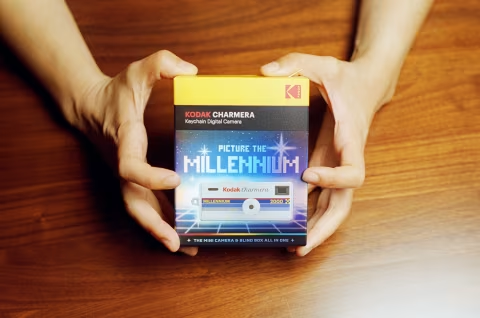
There are seven different camera designs for the new Millennium Kodak Charmera, but you never know which one is inside a box.
You can get all seven of these cameras in a pack, or you can stab in the dark to see what the luck brings.
This surprise-style packaging isn’t new; I’ve been massively addicted to Kinder Surprise eggs in my pre-teens (the chocolate didn’t even matter). But I don’t remember any cameras popping out of those eggs. As a camera-addicted millennial, this toy speaks to me.

The packaging is well-designed, and the box is very easy to open. No fighting with hard plastic shells. Roughly half of the packaging is paper, along with a small paper poster and a card with a QR code linking to a quick start guide on the Kodak/RETO website.

Charmeras became very popular last year, yet this is the first one I’ve seen in-hand — and it’s very small!

The Charmera in this box is the Mirror edition, a “secret” one that’s supposedly rarer than the rest.
It is roughly the size of a lipstick or a pencil eraser. Yet it comes with five physical buttons, an LCD, flash, and an optical viewfinder. While I was not surprised that modern technology allows us to make cameras this small, I was intrigued to see what it would even feel like to press the buttons on something this small.

However, this camera does not come with a memory card, so it is not very useful without one. I had to wait until the next day, when I could pick one up at a local store.
The sales rep was visibly excited when she saw my Charmera, promising that the microSD she had would fit, as it did fit hers as well. I picked the smallest size they had at the store (as Charmera’s image files are tiny and I’m used to shooting 36 frames per roll).

Design and usability.
I found Charmera very easy to get started with. After holding the menu/power button down for a second, the tiny LCD greeted me with a menu where I could choose between stills, video, and options.
The options menu lets you print the date directly on the frame or erase the memory.
The buttons are very small, but they have a nice feel and feedback that makes them quite usable. If you can type on a medium-sized phone in portrait orientation, you can use these buttons.
I ended up spending most of my time in camera (stills) mode. Unfortunately, it would reset to its default (no effects/frames) after I turned the power off (by holding down the menu/power button).
To use the same effect on several photos, I kept the camera turned on: it would sleep after a couple of minutes and wake up with a shutter button and the previously-selected effect in place.
The optical viewfinder on this camera is incredibly small, though it could still be useful in bright sun when the LCD is overpowered.
The most challenging part of operating Charmera is inserting and ejecting the microSD card, which requires a nail and a steady hand. Even though I have an adapter for my microSD card and a card reader on my laptop, I have quickly switched to using the cable to avoid fiddling with the micro card.
The camera has an always-on shutter sound, which I think is appropriate for everyone’s privacy, given how small these devices are.

The filters and the frames.
Of all the filter and frame options, I liked the low-bit-depth Pixel Filters that made something unique out of mundane objects, though they did require some insight and trial and error to get right.
I did not feel that the filters made all photos better; instead, I felt they pushed me to select more suitable scenes, colours, and lighting to make better photos under creative limitations.
The Charmera has a helpful filter indicator icon in live preview mode that tells if it’s a frame or an effect applied, as it could be hard to see subtle differences between the first set of effects and or no-effect in bright sun on a tiny LCD.
Here’s a small herd of cows grazing on a farm field, photographed on all the effects and frames available with the Kodak Charmera Millennium edition:

The video.
Charmera can record 1080p (1440×1080) AVI videos that are high enough in resolution to post on social media, yet also noticeably Lo-Fi.

There’s zero stabilization, and the camera is tiny, so the shake is very noticeable. It is so pronounced that many reviewers compared it to Super 8 footage, which can also shake due to the imprecise placement of film frames on the emulsion.
The sound quality is extremely Lo-Fi, which adds to the overall theme of this camera’s output.
More samples.
Here are a few more photos from the camera (all stills) — with and without filters.
✪ Note: I had to open them all in Photoshop and re-save, as my web service would not upload them to Analog.Cafe. This likely means there’s something slightly exotic about the JPEG encoding used by Charmera, though I still expect it to work mostly everywhere.


Kodak Charmera starter pack.
You will definitely need your own microSD card if you want to take more than four photos. The smallest memory size is enough for Charmera’s tiny 1.6MP JPEGs.
If you have a modern laptop with reversible pill-shaped USB-C plugs, you will need a USB-C-to-USB-C cable or a USB-A-to-USB-C adapter, as Charmera comes with a USB-C-to-USB-A cable only.
If your memory card comes with an SD adapter and your laptop has an SD card slot, you won’t need to connect your Charmera to your computer with a cable, but you will still need to charge it. I think a cable makes it a little more convenient, as the memory card can be very fiddly, but if you’re OK with that, you’ll just need a wall charger with a USB-A plug.
Where to buy.
Kodak Charmeras may be found at select photography shops and retailers. They generally sell for $35 per box or $210 for a box of (non-repeating) six. The links below should help you find one:
❤ Please consider making your Kodak Charmera Millennium edition camera purchase using this link so that this website may get a small percentage of that sale — at no extra charge for you — thanks!
How to take better photos with Kodak Charmera.
The Lo-Fi appeal of Charmera stems from the camera actually being low-fidelity. This means that it has a limited dynamic range, low resolution, slow exposure adjustments, slow recycle rate, and high compression. But as many artists would know, technical limitations can be very helpful in guiding the creative process.
Limited dynamic range means that this camera should be used with caution in bright sunlight. It’s quite possible to make great-looking photos in this light, but your images can also easily lose detail or become noisy.
