Samsung WB2000 (TL350) Digitcam Review
Analogue Gauges, RAW Files, Manual Modes — Oh My!
14 min read by Dmitri.Published on .
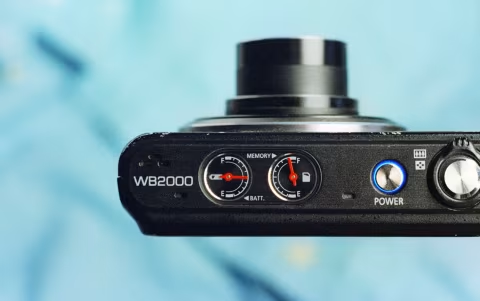
Released in 2010, my Samsung WB2000 (TL350 in some markets) is sixteen years old. Yet, shooting with this camera feels like a modern experience — that is, until the analogue gauges spin up.
Samsung made lots of compact digital cameras in the 2010s that look and work similarly to the WB2000. Yet, only three models featured analogue gauges/dials that read out the battery and memory status: the WB1000, the WB2000, and the NV9. Samsung WB2000 is the only camera of the three that saves in RAW format.
Unfortunately, finding either of the above cameras is quite difficult. It took me about a year of sitting on eBay to finally get my hands on this heavily-worn copy.
But even without the dials and the RAW, this camera can be a bundle of cheap fun (I bought mine for less than $150) with lots of capabilities. I even managed to scan 35mm film in the macro mode! See below.
In this review, I’ll share all the technical details, lots of full-res samples, my experience with this camera, and a few alternatives that you can buy today.
Learn how to get the camera you want on eBay with this guide.
In this review: Technical specifications. The analogue gauges. Image quality. RAW vs. JPEG. Exposure and dynamic range. Design and ergonomics. Build quality. How much does the Samsung WB2000 cost, and where to find one. Samsung WB2000 alternatives. Support this blog & get premium features with GOLD memberships!

Technical specifications.
Lens. 4.3-21.5mm (24-120mm) 𝒇2.4–5.8 Schneider-Kreuznach.
Focus. Min distance: 5cm/2” (macro/wide) or 50cm/1’8” (normal).
Sensor. 10.6MP CMOS sensor 1/2.4” (ISO 80-3200).
Display. 3.0” VGA AMOLED.
Shutter. 1/2000s — 2s. Opticalimage stabilization.
Exposure. Multi-spot, spot, and center-weighted metering; exposure compensation ±2EV; Program/Smart Auto/Aperture Priority/Shutter Priority/Manual.
Processing. Digital image stabilization is available in addition to optical. Scene mode has several settings, including stitched Panorama/Action Panorama, Fireworks, and Beauty Shot. White balance can be set to Auto, Daylight, Cloudy, Fluorescent H/L, Custom, and Tungsten. Date/Time stamps. RAW and JPEG formats Normal/Fine/Super Fine (can record RAW + JPEG). Profiles for correcting aberration/distortion are available in Photoshop/Lightroom.
Battery. Lithium-ion SLB-11A, 1130mAh.
Flash. Auto/Red-eye/Fill/Slow Sync with ±5EV EVC and 4s recharge time.
Video. 1080p H.264 (MPEG-4.AVC) up to 1000FPS.
Chassis. 153g (5.4oz). 99.5mm × 59mm × 21.7mm (3.9” × 2.3” × 0.85”). Aluminum or magnesium alloy shell with plastic components. Operating temperatures: 0-40℃ (32-104℉).
The analogue gauges.
This sixteen-year-old camera is packed with features, including a slow-motion HD video recorder and a very impressive macro mode. That is a whole lot of camera in 2010 and still usable, nay, impressive in 2026.
But of course, the analogue gauges are what caught my attention first and foremost.

Few cameras — digital or film — were ever created with dials like that. And all of them are rare and expensive. The Nikon 35Ti/28Ti may be the best-known example (currently selling for about $1,000). There’s also the Epson R‑D1 ($2,000+) — but that’s about it. My Samsung WB2000 is by far the most affordable camera of this design — but it’s still very rare to find online.
In use, the gauges are a mix of useful and a design embellishment. Because the battery in my copy is quite old, it dies before the gauge reaches zero — but that’s not the camera’s fault; a new battery should work better. The memory gauge is somewhat useful, but I felt that it fails in one important aspect — it displays percentages, not megabytes. Here’s what this means in practice:

The memory gauge indicates “F” the same way for a 4GB memory card and 10MB of internal space. This is very unhelpful if you forget to insert a memory card and rely on the gauge to guess how many photos you can take that day.
Come to think of it, “F” and “E” don’t map well for the memory terminology either.
Still, it’s lots of fun watching little red needles spin up — even if they are mostly decorative. Things like that can make photography fun, but so do the actual key components, like the lens and the sensor — if they are good.

Image quality.
The Schneider-Kreuznach lens design featured on the Samsung WB2000 dates back to the early 20th century and is found in classic 35mm film cameras like the Kodak Retina IIa and Kodak Retina IIIC.
On those cameras in full-frame format, the optics felt sharp and well-corrected, especially for their age. But on my Samsung WB2000, the Schneider-Kreuznach can appear soft, smudgy around the edges, prone to barrel distortion and chromatic aberration.
Setting the camera to RAW can help eliminate barrel distortion (bulging at shorter focal lengths) pretty easily during conversion. Chromatic aberration can also be corrected to a reasonable degree. But the softness will remain — unless you sharpen your image, which will basically replace the softness with noise.
To be fair, the softness is only noticeable if you zoom in, print, or display your images large. I really don’t mind it, and I can even see how it can be beneficial for making photos appear less “clinical.”

The original Schneider-Kreuznach design has certainly been stretched to its limit on this camera. It has been modified from prime to a variable focal-length (zoom) and downsized to work with a tiny sensor. Both of those things require dramatic improvements in precision and light correction to continue performing well. Yet no matter how much technology is thrown at a hundred-year-old formula, an uber-compact lens simply cannot compare to the glorious full-frame prime.
Is it bad? Absolutely not. I’ve made some of my favourite digital images with this camera. For me, the softness and the slight distortion made them feel interesting and genuine.

Perhaps the most impressive aspect of this Schneider-Kreuznach lens is how insanely close you can get to whatever you’re photographing: 5cm or less than two inches!
Not many point-and-shoot cameras, or even dedicated macro lenses, can do that.

The macro mode on this camera is so effective that it can be used to scan 35mm film!
While there are certain downsides to doing so with an old digicam (like reflections due to the lens being so close to the film, plus digital noise), I think it may actually be a viable solution in some cases.
Here, I’ve used the absolute minimum setup: a 95CRI Amaran studio light with a diffuser and a strip of film I literally held in my hand. A better setup would’ve involved a film holder to keep the medium flat and a stand to keep it steady, yet I still got publishable results with some of my frames:
