Ilford Microphen Film Developer Review
6 min read by Dmitri, with image(s) by Betty.Published on .

Ilford Microphen is a black-and-white film developer, made with hydroquinone and phenidone by Harman Technology Ltd., for fine-grained results.
My go-to has always been Rodinal. I like how sharp it makes the film grain, how there’s a recipe for virtually all films, and how well it works with stand development. Unfortunately, it can’t do everything.
Push-processing film increases its grain size and contrast, which can lead to undesirable results, especially if the push is significant. However, Microphen uses technology designed to control both for better results.
In this review: Pushing Ilford HP5+ with Ilford Microphen to ISO 100,000. Developing slow films with Ilford Microphen. Pushing HP5+ to EI 1600 with Ilford Microphen. Mixing, measuring, reusing, and storing Ilford Microphen. Price and availability. Support this blog & get premium features with GOLD memberships!
Pushing Ilford HP5+ with Ilford Microphen to ISO 100,000.
About a year ago, I attempted what may be the world’s first 8-stop push of Ilford HP5+ to ISO¹ 100,000. I tried Rodinal in various dilutions and development times (some were over an hour-long with continuous agitation!) — and it worked terribly. Some of the frames were so damaged that the colours looked inverted in the shadows.
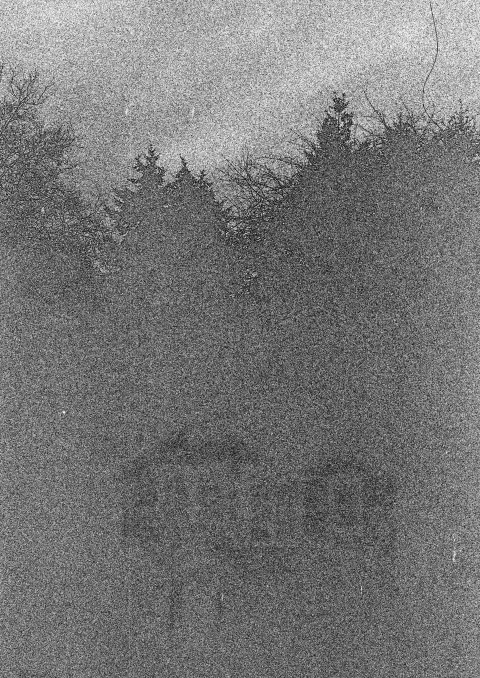
The dark silhouette beneath the tree line in this photo is actually a house with white siding and brown window frames.
Rodinal is incapable of pushing HP5+ six stops without adding excessively large grain, losing virtually all shadow detail, and creating spooky reversal effects.
Though it wasn’t easy, I was able to get images of fairly good quality with Microphen. At that point, I pushed HP5+ way beyond Rodinal’s breakdown point of about +4 stops.
As expected, grain is still very much part of the picture at ISO 100,000. But with Microphen, it’s significantly less severe than anything I’ve tried with Rodinal and the contrast — though high — looks acceptable.
At least in scenes that are already low-contrast, like a fog in a shady town park, below:
¹ — I refer to box film speeds as ISO and pushed/pulled/arbitrary film speeds as EI.

Many developers that give an increase in film speed usually produce a corresponding increase in grain size, MICROPHEN is formulated to overcome this disadvantage, the low alkalinity of the developer reduces grain size and grain clumping.
— Harman Technology Ltd (Microphen technical information sheet).
Developing slow films with Ilford Microphen.
Microphen can do more than rescue reckless experiments. It also works very well with low-ISO films, like the Fujifilm Neopan Acros II.
Although the film is advertised as the finest-grain ISO 100 black-and-white film, detailed scans (I used Nikon SUPER COOLSCAN) can still reveal some granularity on 35mm film.
But not with Microphen, which smoothes the grain out in highlights and cleans it up in shadows without losing any definition or apparent sharpness:


Pushing HP5+ to EI 1600 with Ilford Microphen.
Pushing film two stops with Microphen is largely unremarkable. HP5+, an already grainy, medium-contrast film, appeared largely indistinguishable from its box speed. This is largely the promise of this developer: to preserve the two main qualities of the film’s appearance, grain size and contrast, across push-processing steps.
Pushing film 1-2 stops is easy to do at home (as long as there’s a recipe) and is offered by many labs. It’s also possible to get a similar effect with simple scan-editing techniques. I wouldn’t reach for Microphen just for that (unless controlling contrast is important).
However, slower-speed films and pushes of 3+ stops can absolutely benefit from this developer.

Mixing, measuring, reusing, and storing Ilford Microphen.
I bought Microphen in a thin pouch with two powders. Together, they make up a litre or about a quart of stock solution. The stock is then used to draw amounts from for either further dilution or using as is (based on recipe).
Higher concentrations will give faster results; lower concentrations are not recommended by Harman in some cases. With a 1+3 dilution, you’ll get 4 litres (1L stock + 3L water) of Microphen, which should be enough to develop up to 13 35mm rolls (300ml/roll in a Paterson tank).
Reusing Microphen. According to the documentation, we can reuse the Microphen stock solution, similarly to C-41 developers (but with different numbers). To reuse, we’d develop the first roll normally, then pour the used developer into the stock bottle. Each subsequent use of the developer should add 10% to the development time, up to +90% (nearly double) for the final 10th roll.
The reuse schedule given by Harman is specific to stock dilution.
Stock solutions should last six months in airtight, full (minimal air or a collapsible bottle) containers.
My Chem Log notes indicate that I used mine between December 27th, 2024 and September 7th, 2025 — or about eight and a half months — without issues.
Unopened powder packages, stored in cool, dry conditions at 4–20ºC (44–68ºF), should last indefinitely. But once opened, Harman says you must mix them immediately (and the powders should not be rationed).
Price and availability.
Microphen is a little harder to find than some of the more popular developers, like Rodinal or Ilford DD-X, but not so that you’d have to hunt for it beyond a large photographic retailer with a good film chemistry selection.
The packs currently sell for about $14 (as of December 2015). That’s about $1-$1.40 per roll, depending on how it’s diluted and whether the developer is reused.
❤ By the way: Please consider making your Ilford Microphen film developer purchase using this link so that this website may get a small percentage of that sale — at no extra charge for you — thanks!